

Natural Fragrance Free Soap for Eczema: 2026 Guide
Table of Contents
- Why Fragrance Free Soap Matters for Eczema
- Fragrance-Free vs Unscented Soap: What's the Difference?
- Natural Ingredients for Eczema Relief
- Top Picks: Natural Fragrance Free Soap for Eczema
- Eczema Skincare Routine Tips for Daily Management
- The Role of pH Balance and Water Hardness in Eczema Care
-
Common Mistakes to Avoid When Choosing Eczema Soap
- Mistake 1: Confusing lather with cleaning power
- Mistake 2: Ignoring water hardness
- Mistake 3: Assuming "natural" essential oils are safe
- Mistake 4: Overlooking the acne-prone-eczema overlap
- Mistake 5: Switching products too fast to identify the trigger
- Mistake 6: Skipping moisturizer because the soap felt gentle
- Conclusion
- Frequently Asked Questions
Last Updated: September 10, 2026
Why Fragrance Free Soap Matters for Eczema
If you have eczema, the soap in your shower is one of the most important purchases you'll make. Fragrance is the leading cause of allergic contact dermatitis in personal care products, and a scented bar can undo weeks of skin care in one wash (the American Academy of Dermatology). At Pasaku Soap Company, we hand-pour every bar in small batches because the ingredient list matters when your skin barrier is compromised.

Eczema is a chronic inflammatory condition in which the skin barrier fails to hold moisture and block irritants, causing dryness, redness, and intense itching. That damaged barrier lets fragrance chemicals penetrate deeper than on healthy skin.
The fix sounds simple: switch to a natural fragrance free soap for eczema. In practice, most shoppers pick the wrong bar.
Fragrance-Free vs Unscented Soap: What's the Difference?
Fragrance-free and unscented soaps are not the same thing, and the gap between them is where most eczema sufferers get burned. A fragrance-free product contains no added fragrance. An unscented product may still contain a masking fragrance added to neutralize the smell of raw ingredients, and that masking agent can irritate reactive skin as badly as perfume.
The FDA guidance on cosmetic labeling allows companies to list fragrance components under the single term "fragrance," which makes reading labels harder than it should be. If a bar says "unscented" but lists "fragrance" or "parfum" on the label, treat it as scented.
For eczema-prone skin, fragrance-free is the safer standard. Check for these on the label:
- "Fragrance," "parfum," or "aroma" listed as an ingredient
- Essential oils marketed as natural scent (lavender, citrus, eucalyptus)
- "Unscented" claims without a full ingredient list
Natural Ingredients for Eczema Relief
Certain plant-based ingredients genuinely calm eczema, while others only sound gentle.
Ingredients to Look For
The best natural soaps for eczema share a short list of proven skin supporters. Colloidal oatmeal is recognized by the American Academy of Dermatology as an effective soother for itchy, irritated skin. Shea butter and olive oil deliver emollient, lipid-replenishing moisture that helps reduce transepidermal water loss. White kaolin clay adds slip and a creamy lather without stripping the skin's microbiome. Look for sulfate-free, paraben-free formulas with glycerin preserved, since glycerin is a natural humectant that draws water into the skin.
Ingredients to Avoid
Just as important is what you leave out. Skip bars built on harsh surfactants, synthetic dyes, synthetic preservatives like parabens, and added essential oils. Lanolin-free is often safer too, since some eczema sufferers react to it. Don't assume "natural" means safe: botanical essential oils are a frequent trigger.
Top Picks: Natural Fragrance Free Soap for Eczema
The best natural fragrance free soap for eczema pairs a short, plant-based ingredient list with a neutral scent profile. Every pick below is hand-poured in small batches, cured at least six weeks, and built around shea butter and olive oil.
| Product | Price | Best For | Format |
|---|---|---|---|
| The Alabaster | $9.00 | Fragrance-free daily cleansing | Single bar |
| The Soap Trio | $25.00 | Building a full routine | Any 3 bars |
| The Premier Collection | $45.00 | Gifting and full ritual | 4 bars + ceramic dish |
The Alabaster: Unscented Plant-Based Artisan Soap
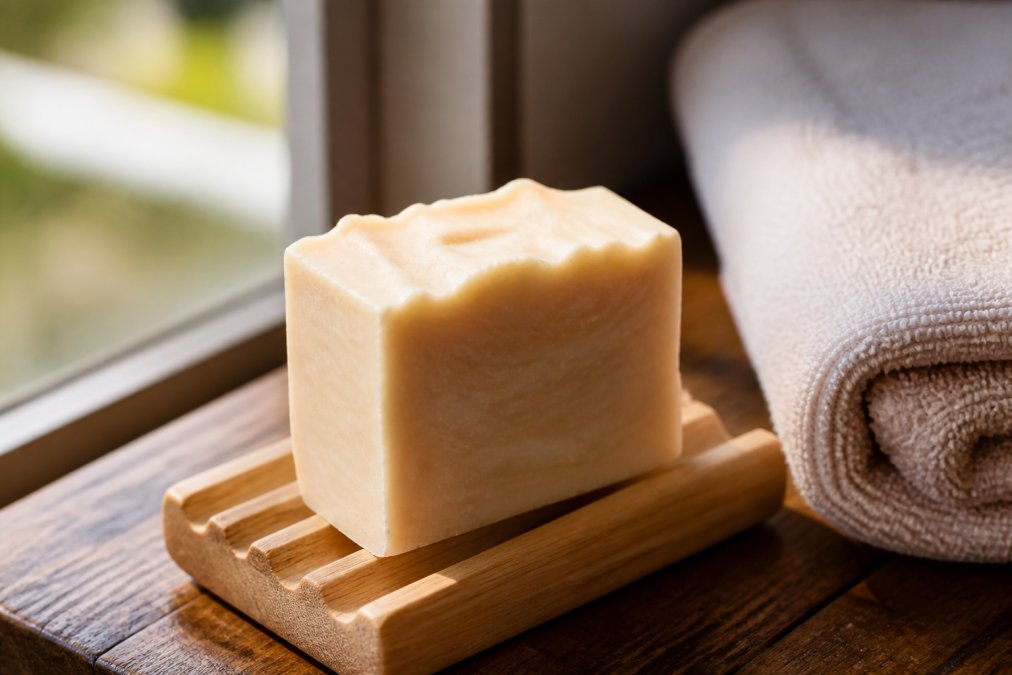
Our top pick for reactive skin is The Alabaster. It is a truly fragrance-free bar with a neutral scent profile, formulated with shea butter, olive oil, and white Kaolin clay for a dense, lotion-like lather. It contains no essential oils, so it suits people who react even to "natural" scents. The one drawback: with no fragrance to mask the base oils, the bar smells faintly of soap itself. Most sensitive-skin users consider that a fair trade.

The Soap Trio: Customizable Bundle
If you want to test a few formulas before committing, The Soap Trio lets you choose any three bars and save automatically. Each 4.0 oz bar is beveled and cured at least six weeks, preserving the natural glycerin. Best for households where one person needs fragrance-free and another prefers a lightly scented bar.
The Premier Collection: Complete Gift Set
For gifting, The Premier Collection bundles four artisan bars with a hand-built ceramic ritual dish in a stamped apothecary box. It's the easiest way to introduce someone with sensitive skin to a fragrance-free routine without label research.

Eczema Skincare Routine Tips for Daily Management
Good eczema skincare routine tips start with one rule: keep water lukewarm and contact brief. Hot water and long showers strip the skin's natural oils and worsen dryness. But the difference between a routine that holds the barrier together and one that erodes it comes down to timing, sequence, and how much product you use.
The adult daily rhythm
A practical daily rhythm looks like this:
- Bathe in lukewarm water, aim for roughly 90 to 95°F, or water that feels neutral on the wrist, not warm, for 5 to 10 minutes
- Use a fragrance-free, pH-balanced cleanser only on soiled areas; the rest of the body can rinse with water alone
- Pat dry with a soft towel, leaving skin slightly damp rather than fully dry
- Apply a thick moisturizer within three minutes of toweling off, while the skin is still holding water
- Reapply moisturizer at least twice daily, and again after any handwashing
The three-minute window matters because transepidermal water loss accelerates the moment skin stops being wet. Moisturizer on damp skin traps that water; on fully dry skin it mostly sits on the surface. Many people moisturize faithfully but wait ten minutes after the shower, then wonder why it isn't working.
On quantity: most adults under-apply. A useful benchmark is a full fingertip unit, from the tip of an adult index finger to the first crease, for an area roughly the size of two adult palms. Full-body coverage takes several fingertip units, not a thin smear.
The pediatric protocol is not just a smaller version
Children need a genuinely different routine, not a scaled-down adult one:
- Shorter baths. Cap baths at 5 to 10 minutes for most children, and 5 minutes or less during an active flare. Longer soaks macerate the skin and worsen itching.
- Cooler water. Children's skin is thinner and more reactive to heat. Water that feels comfortably warm to an adult can feel hot to a child and trigger itching within minutes of getting out.
- Two adults, or one adult and a plan. One caregiver bathes while the other has the towel, moisturizer, and any prescription topical open and within reach. Fumbling for a tube while a wet, itchy child waits defeats the three-minute window.
- Pat, don't rub. Rubbing with a towel is a mechanical irritant on pediatric skin. Press the towel against the skin to absorb water and leave it slightly damp.
- Dress immediately. Cotton pajamas put on right after moisturizer help seal in hydration and reduce scratching overnight. Consider soft cotton mittens or long sleeves for children who scratch in their sleep.
- Patch-test new products. Before applying a new soap or moisturizer to a child's whole body, test it on the inner forearm for 24 to 48 hours.
What stays the same for everyone
Regardless of age, three principles hold: keep the routine boring and consistent, introduce only one new product at a time so you can identify what helps or hurts, and treat moisturizing as the main event, cleansing is the setup, not the point. During a flare, cleanse less often, shorten baths, and lean harder on moisturizer and any prescribed topical.
The Role of pH Balance and Water Hardness in Eczema Care
Two factors most guides ignore decide how well your soap works: pH and water hardness. Healthy skin sits at a slightly acidic pH, and true soap is naturally alkaline. A pH-balanced bar cleanses without pushing the skin's surface too far from its natural state, which matters when the barrier is already weak.
Hard water is the second variable. Minerals in hard water react with soap and form a sticky residue that resists rinsing, leaving a film that traps irritants against the skin and interferes with lather. This is why a bar that works well while traveling can feel drying at home. A soap rich in shea butter and olive oil lathers more reliably in mineral-heavy water and rinses cleaner, which is why we build every Pasaku bar around that base rather than tallow or synthetic surfactants.
Common Mistakes to Avoid When Choosing Eczema Soap
The single biggest mistake is trusting the front of the package over the ingredient list. "Natural," "gentle," and "dermatologist-tested" are marketing terms, not regulated guarantees. Flip the bar over and read the actual ingredients. Beyond that, the mistakes that cause flares tend to be mechanical rather than label-based.
Mistake 1: Confusing lather with cleaning power
Heavy, billowing foam usually signals harsh surfactants, the class of ingredients that strip the skin's lipid barrier and leave it tight and reactive. A gentle, fragrance-free bar built on shea butter and olive oil produces a creamier, lower-volume lather. That is not a defect. Lather is a cosmetic signal, not a measure of how clean skin gets. If a bar foams like dish soap, treat that as a warning.
Mistake 2: Ignoring water hardness
This is the mistake almost no guide mentions. Minerals in hard water, primarily calcium and magnesium, react with soap to form a sticky, insoluble residue called soap scum. That film resists rinsing, traps irritants and bacteria against the skin, and interferes with lather, pushing people to use more product and scrub harder. The result is a bar that works fine at one address and feels drying at another, with no change to the soap itself.
A few practical responses:
- If your home has hard water, a whole-house softener or a showerhead filter can meaningfully change how any soap behaves on your skin.
- Soaps rich in shea butter and olive oil tend to lather and rinse more reliably in mineral-heavy water than tallow-based or synthetic-surfactant bars.
- If you can't change your water, shorten contact time, rinse thoroughly, and moisturize immediately after.
Mistake 3: Assuming "natural" essential oils are safe
Botanical essential oils, lavender, citrus, eucalyptus, tea tree, peppermint, are among the most common triggers of allergic contact dermatitis in people with eczema. They are natural, and they are also fragrance. For reactive skin, a truly fragrance-free bar with no essential oils is the safer default, even when the oil is marketed as calming.
Mistake 4: Overlooking the acne-prone-eczema overlap
Many people have both eczema and acne-prone skin, and the two conditions pull in opposite directions. Eczema wants occlusive, emollient, barrier-repairing ingredients. Acne wants non-comedogenic, lighter formulations that won't clog pores. A heavy butter-based bar that soothes eczema on the arms can trigger breakouts on the back or chest.
The bridge is the term "non-comedogenic", formulated to minimize pore-clogging. For skin dealing with both conditions, look for fragrance-free bars that pair emollients like shea butter and olive oil with lighter, non-comedogenic carriers, and avoid heavy occlusives like coconut oil or cocoa butter on acne-prone areas. Patch-test on the body before facial use.
Mistake 5: Switching products too fast to identify the trigger
When a flare happens, the instinct is to change everything at once, making it impossible to know what helped or hurt. Introduce one new product at a time, give it one to two weeks, and keep a simple log of what you used and how your skin responded. Reactions to contact allergens often show up a day or two after exposure, so the culprit is rarely the product you used this morning.
Mistake 6: Skipping moisturizer because the soap felt gentle
A gentle cleanser is not a moisturizer. Even the mildest fragrance-free bar removes some surface lipids. If you don't replace them within minutes of toweling off, the barrier stays compromised no matter how good the soap is.
Conclusion
Finding a cleanser that calms rather than triggers your skin comes down to reading labels, avoiding fragrance in every form, and choosing a bar built on emollient, plant-based ingredients. That is why Pasaku Soap Company exists: hand-poured, small-batch artisan soap made without synthetic fragrance, harsh surfactants, or fillers.
Start with The Alabaster for a truly fragrance-free daily cleanse, or build a routine with The Soap Trio to test a few formulas. Every bar is cured for six weeks to preserve its natural glycerin, so your skin gets the moisturizing cleanse it has been missing. Get started with Pasaku Soap Company and give your skin barrier the gentle, fragrance-free care it deserves.
Frequently Asked Questions
What kind of soap is best for hypersensitive skin?
A fragrance-free, pH-balanced soap made with gentle surfactants and moisturizing ingredients like shea butter or colloidal oatmeal is best. Avoid sulfates, parabens, and essential oils. For example, The Alabaster from Pasaku Soap Company uses plant-based oils and white kaolin clay to cleanse without stripping the skin barrier.
What is the best fragrance-free soap for sensitive skin?
The best fragrance-free soap for sensitive skin contains no synthetic fragrances or essential oils, and includes emollients like shea butter, olive oil, or glycerin. It should be free of sulfates and parabens. Handcrafted options such as The Alabaster are formulated with natural ingredients that support the skin microbiome and reduce irritation.
Does fragrance-free soap help with eczema flare-ups?
Yes, fragrance-free soap can help prevent eczema flare-ups because it avoids common irritants that trigger itching and redness. By using a gentle, non-drying cleanser, you support the skin barrier and reduce transepidermal water loss. Pair it with a moisturizer and lukewarm baths for best results.
What ingredients should I avoid in soap for eczema?
Avoid synthetic fragrances, essential oils, sulfates (like sodium lauryl sulfate), parabens, and lanolin. These can strip natural oils, disrupt the skin barrier, and cause allergic reactions. Also skip soaps with high pH, which can worsen dryness and itching.
How do I build an eczema skincare routine with fragrance-free soap?
Start with a lukewarm shower using a fragrance-free soap like The Alabaster, pat dry, and immediately apply a thick moisturizer. Do this twice daily and after any flare-up. Avoid hot water and harsh scrubbing. For extra relief, add colloidal oatmeal baths and wear soft fabrics.