

How to Moisturize Skin After Hard Water Wash: A Step-by-Step Routine
Quick Summary
To moisturize skin after hard water wash, rinse until skin no longer feels slick, pat it slightly damp, and apply a thin layer of moisturizer within 1 to 3 minutes. Hard water minerals leave a film that can make skin feel tight, so longer rinsing and quick moisturizing help restore comfort after each wash.
- Rinse for 30 to 60 seconds until skin feels clean, not slick.
- Pat skin dry and leave it slightly damp before moisturizing.
- Apply moisturizer within 1 to 3 minutes while skin still holds water.
- Use lukewarm water, since hot water strips natural oils and worsens dryness.
- Reapply a second thin layer if skin still feels tight within an hour.
Table of Contents
- Why Hard Water Leaves Skin Dry and Tight
-
The Post-Wash Routine: Step by Step
- Step 1: Set the water temperature and wet your skin (10-20 seconds)
- Step 2: Use a small amount of gentle, pH-balanced cleanser (about 30 seconds of washing)
- Step 3: Rinse thoroughly (30-60 seconds)
- Step 4: Pat dry and leave skin slightly damp (10-15 seconds)
- Step 5: Apply moisturizer within 1-3 minutes, while skin is still damp
- Step 6: Reapply once if skin still feels tight
- How to Moisturize Skin After Hard Water Wash for Dry Skin
- How to Moisturize Skin After Hard Water Wash for Oily Skin
- Choosing a Face Wash That Works in Hard Water
- How to Reverse the Effects of Hard Water on Skin
- Next Step: Build Your Hard-Water Skin Routine Tonight
- Frequently Asked Questions
Why Hard Water Leaves Skin Dry and Tight
Hard water is common across the United States, and it can leave your skin feeling dry, tight, or itchy after every wash. Pasaku Soap Company hand-pours its bars in small batches, and customers in hard-water areas often ask why their skin feels worse after washing. The short answer is that minerals in the water change how soap behaves on your skin.
Hard water contains dissolved calcium and magnesium (Hardness of Water). When these minerals meet soap, they form a sticky film instead of a rich lather. That film is hard to rinse away, so some of it stays on your skin. Your skin then feels coated, not clean.
Mineral residue and soap buildup on skin
Soap residue is the main reason hard water causes problems. Over days and weeks, a thin layer of mineral-soap film can build up on your face, hands, and body. This layer can make skin feel rough and dull.
Look for these signs of buildup:
- Skin feels slick or coated after rinsing
- Towels and shower walls have a white, chalky film
- Lather is thin, even with plenty of soap
- Skin feels tight within a few minutes of drying
Why hard water can cause dryness, tightness, or itching
Healthy skin has a protective outer layer called the skin barrier. It holds in moisture and keeps out irritants. Mineral residue and harsh cleansing can disrupt that barrier, so water leaves the skin faster. The result is dryness, tightness, and sometimes itching.
Many people also use more soap in hard water because they want a better lather. More soap means more residue, which can make the problem worse. A simple fix is to use less product and rinse longer.
The Post-Wash Routine: Step by Step
Hard water does not have to ruin your skin. A short, consistent routine helps your skin recover after every wash. What most guides leave out is the sequence: how long to wash, how much product to use, how long to rinse, and how quickly to moisturize. Here is a repeatable routine with concrete timing and amounts.
Step 1: Set the water temperature and wet your skin (10-20 seconds)
Start with lukewarm water, roughly the temperature of a comfortable bath. Hot water strips natural oils and makes dryness worse. Wet your face and body fully before applying any cleanser so the product spreads evenly and you need less of it.
Step 2: Use a small amount of gentle, pH-balanced cleanser (about 30 seconds of washing)
Choose a cleanser that is gentle and pH-balanced. Skin naturally sits at a slightly acidic pH, and harsh cleansers can push it higher. A common pattern is to use far more product than needed: for the face, a nickel-sized amount or a single pump is usually enough; for the body, a quarter-sized amount per limb is plenty. Our Alabaster unscented plant-based soap is fragrance-free, which suits sensitive skin.
Massage the cleanser over your skin for about 30 seconds, then move on. Avoid scrubbing with a washcloth or loofah, which can add friction on already-compromised skin.
Watch out: If your lather is thin and you are tempted to add more soap, add water instead. More product in hard water means more mineral-soap residue left on your skin.
Step 3: Rinse thoroughly (30-60 seconds)
Rinse until your skin feels clean and smooth, with no slippery film left behind. Take your time here, since leftover residue is the main source of tightness. A practical check: run your hand over your forearm. If it feels slick or coated rather than clean, keep rinsing. Rinsing longer is one of the few free changes that reliably reduces the tight feeling after a hard-water wash.
Step 4: Pat dry and leave skin slightly damp (10-15 seconds)
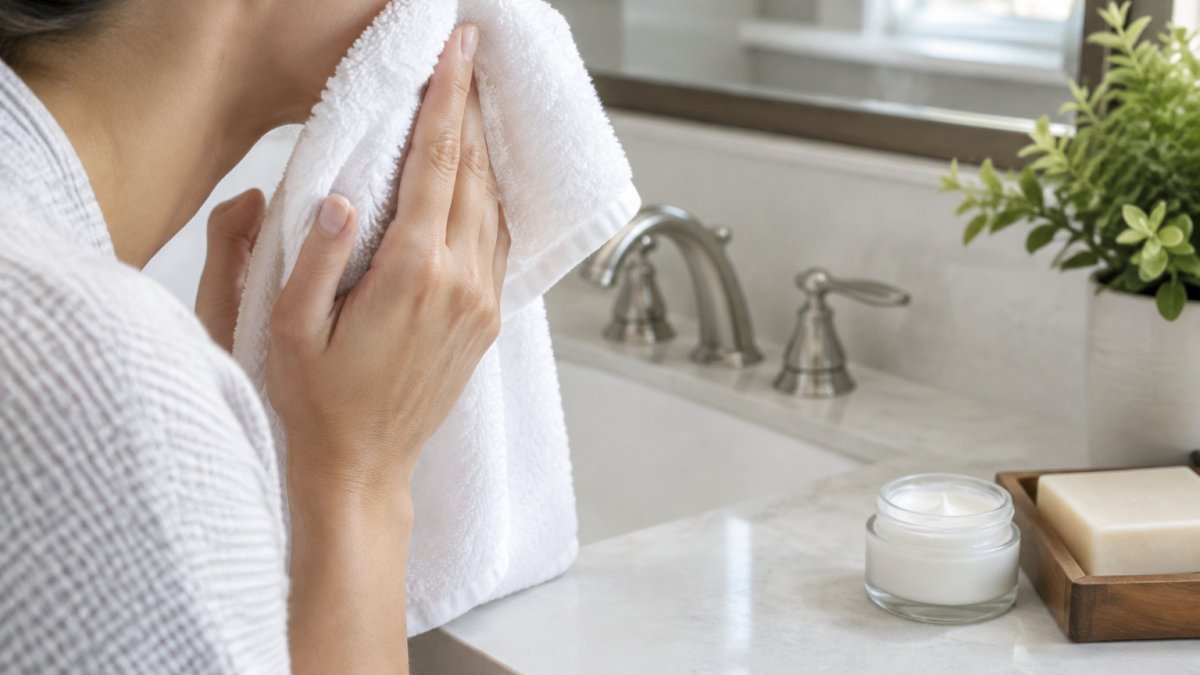
Pat your skin dry with a soft towel instead of rubbing. Leave your skin slightly damp, not dripping. The goal is to keep a thin layer of water on the surface so the moisturizer has something to hold in.
Step 5: Apply moisturizer within 1-3 minutes, while skin is still damp
Apply moisturizer within a few minutes of patting dry, while your skin still holds water. Damp skin absorbs moisturizer better than dry skin. Use a thin, even layer: for the face, about a pea-sized amount; for each arm or leg, about a dime-sized amount. Your skin should feel comfortable, not greasy.
If you use a toner, apply it before moisturizer and only if your skin is not irritated. If you use sunscreen in the morning, apply it after moisturizer and wait about a minute so the layers do not pill.
Step 6: Reapply once if skin still feels tight
If your skin feels tight within an hour, apply a second thin layer of moisturizer rather than a thick one. Reapplying a small amount twice is usually more comfortable than one heavy application, especially on oily or acne-prone skin.
This sequence takes about two minutes from start to finish. Repeat it after every wash, and adjust the amount of moisturizer based on how your skin feels the next morning.
The routine has six steps, each with a timing or amount the article gives.
| Step | What to do | Time or amount |
|---|---|---|
| 1. Wet skin | Use lukewarm water and wet skin fully | 10-20 seconds |
| 2. Cleanse | Use a gentle, pH-balanced cleanser | About 30 seconds of washing |
| 3. Rinse | Rinse until skin feels clean, not slick | 30-60 seconds |
| 4. Pat dry | Pat dry and leave skin slightly damp | 10-15 seconds |
| 5. Moisturize | Apply moisturizer while skin is still damp | Within 1-3 minutes |
| 6. Reapply | Add a second thin layer if skin feels tight | Once, if still tight within an hour |
How to Moisturize Skin After Hard Water Wash for Dry Skin
If your skin is dry, choose a richer moisturizer. Look for ingredients that do different jobs:
- Humectants like glycerin draw water into the skin.
- Emollients like shea butter and squalane smooth and soften the surface.
- Occlusives like petrolatum or thick creams seal moisture in.
Apply a thicker cream at night and a lighter layer during the day. If you still feel tight after a few days, use a little more product and reapply once or twice daily.
How to Moisturize Skin After Hard Water Wash for Oily Skin
Oily skin still needs moisture after hard water exposure. Dehydrated skin can produce even more oil, so skipping moisturizer usually backfires.
Choose a lightweight, water-based lotion or gel. Look for labels that say non-comedogenic. Apply a small amount, and wait a minute before adding makeup or sunscreen.
Choosing a Face Wash That Works in Hard Water
When you shop for a face wash, look for a gentle, fragrance-free formula. Our Best natural soap for sensitive skin guide explains what to look for when choosing a cleanser.
Watch how your skin feels after a week before you judge a product.
Pasaku's The Alabaster unscented soap is a good starting point if you have sensitive skin. It is hand-poured in small batches and made with shea butter and olive oil.

How to Reverse the Effects of Hard Water on Skin
Some people look for ways to treat hard water at the source. Before spending money on a device, it helps to know how hard your water actually is and what each option can and cannot do. This is the step most guides skip.
Step 1: Check your water hardness
Water hardness is usually reported in milligrams per liter (mg/L) or grains per gallon (gpg). Water hardness is commonly classified by mineral content, and your water utility's annual water quality report will list your local level. You can find your local number from your water utility's annual water quality report, which is usually published online, or with an inexpensive test strip sold at hardware stores. Knowing your number helps you decide whether a routine change is enough or whether treatment is worth considering.
Step 2: Understand what each option does
- Water softeners replace calcium and magnesium with sodium or potassium through ion exchange. They reduce mineral content at the source, but they cost several hundred to over a thousand dollars installed, require salt refills, and add sodium to the water. They are not always practical for renters.
- Shower filters vary widely. Some reduce chlorine and sediment, but most carbon or media filters do not remove calcium and magnesium, so they may improve feel without changing hardness. Check the label for claims about hardness specifically.
- Point-of-use filters under the sink can reduce minerals, but capacity and cost vary, and they do not treat the shower.
None of these options moisturizes skin. They reduce exposure to minerals, which is different from restoring hydration and barrier function. A moisturizer is still the step that directly addresses dryness.
Step 3: Use toners and deep-cleansing products carefully
Toners are used by some people for a fresh feel. Use them carefully, since some ingredients can sting dry or irritated skin. A common pattern is to use a toner only on non-irritated skin and to skip it entirely during a flare. Our The Grove eucalyptus tea tree lavender soap uses a clay blend for a deeper cleanse.
Watch out: Do not stack a deep-cleansing product, a toner, and an exfoliant in the same routine. That combination can irritate skin that is already stressed by hard water.
Step 4: Know when to see a professional
If your skin stays irritated for more than a week despite a gentle routine and consistent moisturizing, see a dermatologist. They can help you figure out what is causing the problem and whether an underlying condition such as eczema is involved.
Next Step: Build Your Hard-Water Skin Routine Tonight
Start with one change tonight: rinse longer and moisturize while your skin is still damp. Hard water is hard on skin, but a simple routine can make a big difference. Pasaku Soap Company makes hand-poured soaps, and our Alabaster soap is a gentle place to begin.
Frequently Asked Questions
How do I fix dry skin from hard water?
Start by washing with lukewarm water and a gentle, pH-balanced cleanser, then rinse thoroughly to clear mineral residue. Pat your skin dry and apply a moisturizer while it is still damp, which helps trap water in the skin. If dryness or tightness continues for more than a couple of weeks, or your skin looks cracked, inflamed or painful, see a dermatologist for an evaluation.
What is the best moisturizer for skin affected by hard water?
Look for a moisturizer that combines a humectant such as glycerin or hyaluronic acid with an emollient like shea butter or ceramides, and seal it with a light occlusive if your skin is very dry. People with dry skin usually do well with a thicker cream, while people with oily skin often prefer a lightweight lotion or gel. Apply it within a minute or two of patting dry for the best results.
Can hard water cause itchy skin?
Yes, hard water can contribute to itching. Calcium and magnesium minerals, along with soap residue, can leave the skin feeling tight and irritated, and dryness itself often causes itch. Rinsing more thoroughly, using less soap, and moisturizing promptly can reduce the problem. Persistent itching, rash or redness should be checked by a dermatologist.
How soon should you moisturize after washing your face?
Moisturize within about one to two minutes after washing, while your skin is still damp. Damp skin holds water better than dry skin, so the moisturizer locks in hydration more effectively. Use a small pea-sized amount for the face and a larger amount for the body, and reapply during the day if your skin feels tight.
