

7 Benefits of Jojoba Oil for Face Backed by Evidence
Quick Summary
Jojoba oil benefits the face mainly by moisturizing dry skin and softening its texture, because its wax esters closely resemble the natural sebum your skin already produces. It is often described as noncomedogenic, though responses vary. Its antibacterial and antioxidant effects are supported mostly by lab studies, not proven human results.
- Moisturizing dry skin has the most consistent support for jojoba oil.
- Apply two to four drops to slightly damp skin, as a final layer before sunscreen in the morning.
- Patch test for three to five days before using jojoba oil on your full face.
- Antibacterial and antifungal benefits come from lab studies, not proof of clearing acne.
- Retinoids and acids can dry skin, so jojoba oil may help comfort; do not mix it into them.
Table of Contents
- What Jojoba Oil Is and Why Its Structure Matters for Skin
-
7 Benefits of Jojoba Oil for Face: What the Evidence Supports
- Moisturizing Dry Skin and Improving Softness
- Noncomedogenic Properties and Pore-Clogging Concerns
- Antioxidant Content, Including Vitamin E
- Anti-Inflammatory Effects and Soothing Redness
- Antibacterial and Antifungal Properties
- Fine Lines, Wrinkles, and the Appearance of Aging
- Sunburn Relief and Skin Soothing
- Skin Softness, Smoothness, and Flakiness
- Benefits of Jojoba Oil for Face Everyday: Who Can Use It Daily
- Benefits of Jojoba Oil for Face Overnight and How to Apply It
- How to Use Jojoba Oil for Face by Skin Type
- Jojoba Oil vs. Coconut Oil for Face: Which Suits Your Skin
- Patch Testing, Side Effects, and Choosing a Quality Bottle
- Start Your Jojoba Routine With a Patch Test Today
- Frequently Asked Questions
What Jojoba Oil Is and Why Its Structure Matters for Skin
Last Updated: November 4, 2026
Jojoba oil is a liquid wax pressed from the seeds of the jojoba shrub, which grows in the Sonoran Desert of the American Southwest and northern Mexico. Jojoba oil can belong in a face routine for many people, with some caveats.
Most cooking and cosmetic oils are triglycerides, molecules built from glycerol and three fatty acids. Jojoba is different. It is composed mainly of long-chain wax esters, which are single fatty acids bonded to single fatty alcohols. That chemistry makes it chemically stable, slow to turn rancid, and resistant to the oxidation that shortens the shelf life of many other oils.
How Its Wax Esters Resemble Your Skin's Natural Sebum
The most cited reason jojoba works well on the face is that its wax esters closely resemble the sebum your skin already produces. Sebum is the oily secretion of your sebaceous glands, and it contains wax esters that help form the surface film protecting your skin barrier (ncbi.nlm.nih.gov).
This similarity does not make jojoba a cure-all. It means jojoba is a reasonable choice for a moisture-retaining layer, and it is generally well tolerated by skin types that react poorly to heavier oils. Treat it as a barrier-supporting ingredient, not a treatment for a specific condition.
7 Benefits of Jojoba Oil for Face: What the Evidence Supports
Jojoba oil is widely promoted for facial skin, and some of those claims rest on firmer ground than others. The list below separates the benefits with reasonable support from those that remain largely anecdotal, and it flags where the evidence is laboratory-based rather than proven in human trials.
A note on how to read this: most published jojoba research is in vitro (cell and tissue studies) or in animals, and much of the human evidence is small or based on traditional use rather than large randomized trials.
Moisturizing Dry Skin and Improving Softness
This is the benefit with the most consistent support. Jojoba can form a light film on the surface of the skin, which may help the skin hold onto the moisture it already has.
A practical note: jojoba works best applied to slightly damp skin, which locks in water rather than trapping dryness underneath.
Noncomedogenic Properties and Pore-Clogging Concerns
Jojoba is often described as noncomedogenic, meaning it is not expected to clog pores for most people. That said, individual responses vary, and a noncomedogenic label is a guideline, not a guarantee. If you have acne-prone skin, introduce jojoba slowly and watch for breakouts over two to three weeks.
Antioxidant Content, Including Vitamin E
Jojoba oil contains small amounts of vitamin E (tocopherols), a fat-soluble antioxidant. Sunscreen remains the most important defense against UV-related skin damage.
Anti-Inflammatory Effects and Soothing Redness
If redness is persistent or painful, that is a reason to see a clinician, not to layer on more oil.
Antibacterial and Antifungal Properties
Some lab studies report that jojoba oil and its derivatives inhibit certain bacteria and fungi, which is one reason it appears in acne and dandruff products. These are petri-dish findings, not proof that jojoba clears acne on a human face. It can be a supportive ingredient in an acne routine, but it does not replace benzoyl peroxide, salicylic acid, or prescription treatment.
Fine Lines, Wrinkles, and the Appearance of Aging
It does not contain retinoids or peptides and has not been shown in robust trials to reverse wrinkles. Expect a softer, better-hydrated appearance, not a structural change in the skin.
Sunburn Relief and Skin Soothing
It is not a substitute for after-sun care that includes cooling and rehydration, and it should not be applied to blistered or broken skin. For any burn beyond mild redness, seek medical advice.
Skin Softness, Smoothness, and Flakiness
The effect is cosmetic and reversible, which is exactly what you want from a moisturizing oil.
The benefits vary in strength of evidence, so here is how the main claims compare.
| Benefit | Evidence level | Note |
|---|---|---|
| Moisturizing dry skin | Most consistent support | Works best on slightly damp skin |
| Noncomedogenic | Guideline, not guarantee | Introduce slowly if acne-prone |
| Antioxidant (vitamin E) | Small amounts present | Sunscreen remains most important |
| Antibacterial and antifungal | Lab studies only | Not proof it clears acne |
| Fine lines and wrinkles | Not shown in robust trials | Softer appearance, not structural change |
| Sunburn relief | Soothing, not a substitute | Avoid blistered or broken skin |
Benefits of Jojoba Oil for Face Everyday: Who Can Use It Daily
Jojoba suits most skin types for daily use, but it is not universal. People with dry, normal, or combination skin often tolerate it well as a daily moisturizer or serum layer. Oily and acne-prone skin can use it too, typically in smaller amounts and after patch testing. Anyone with a known sensitivity to plant-derived ingredients, including those in the Asteraceae family or other seed oils, should consult a dermatologist first.
Benefits of Jojoba Oil for Face Overnight and How to Apply It
Overnight use is one of the most popular ways to apply jojoba. Because it is slow to oxidize and absorbs gradually, it can serve as a final occlusive step before bed. Apply two to four drops to clean, slightly damp skin after your evening cleanse. Pair it with a gentle, fragrance-free cleanser in the morning and night to keep your routine simple.
How to Use Jojoba Oil for Face by Skin Type
A single approach rarely fits every face. The guidance below covers amount, frequency, application order, and whether to apply to damp skin, with variations for the main skin types. It also addresses how jojoba fits around acne treatments and exfoliating acids, which is where most routines go wrong.
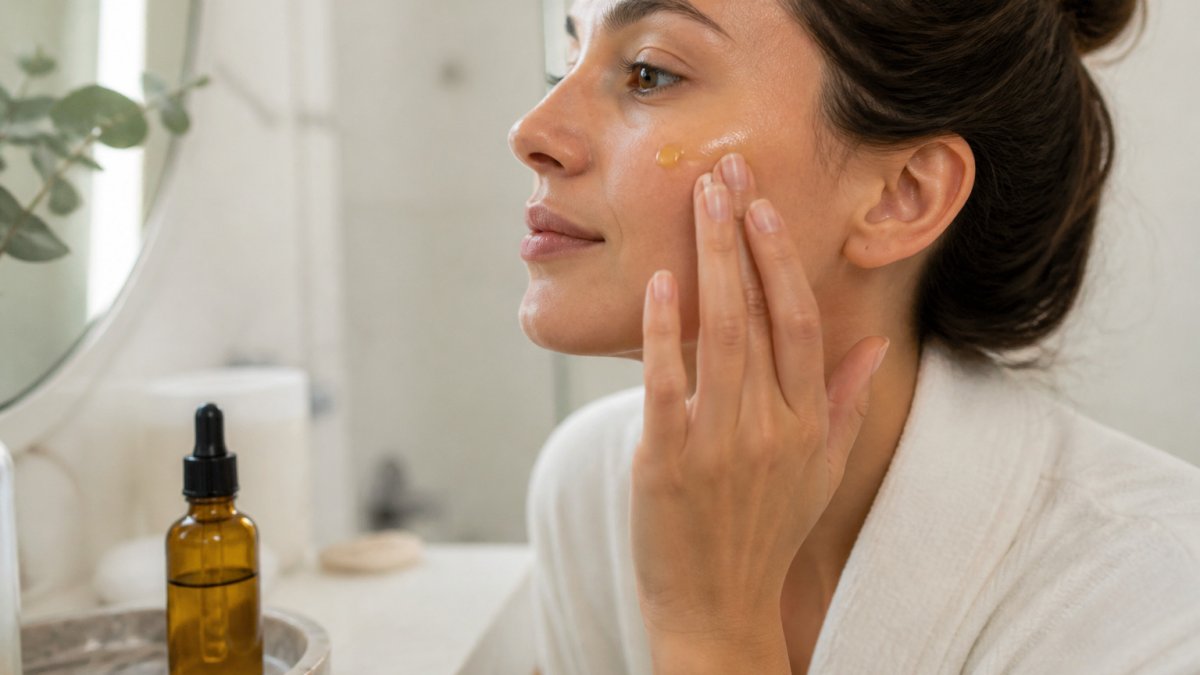
The universal rules first
Apply jojoba as one of the last steps in your routine, after water-based serums and moisturizer and before sunscreen in the morning. The exception is if you use it as your only moisturizer, in which case it goes after cleansing and any treatment steps.
Damp skin matters. Applying jojoba to slightly damp skin after cleansing helps trap water rather than sealing a dry surface, which is the difference between moisturized and merely coated.
Dry skin
Apply two to four drops after moisturizing, morning or night. Dry skin can often handle jojoba twice daily, and it layers well over a hyaluronic acid serum applied to damp skin. If flaking is severe, a thicker occlusive at night may still be needed.
Normal skin
One to two drops as a finishing layer, most often at night. Normal skin rarely needs jojoba in the morning if sunscreen or a moisturizer already provides enough emollience.
Oily or acne-prone skin
One drop, applied sparingly, and only after a patch test. Apply it at night rather than under makeup, and avoid the oiliest zones if you notice congestion. Jojoba can be used alongside acne treatment, but it should not replace it.
Sensitive skin
Begin with one drop every other night and increase only if the skin stays calm. Fragrance-free, single-ingredient jojoba is the safer starting point; blends with essential oils add irritation risk.
Combination skin
Use one to two drops on the drier areas (cheeks, around the mouth) and skip or lightly apply to the T-zone. This is often more effective than a uniform application.
Fitting jojoba around retinoids, benzoyl peroxide, and exfoliating acids
This is the part most guides skip. Retinoids, benzoyl peroxide, and exfoliating acids (AHAs and BHAs) can make skin drier and more reactive, and jojoba can help buffer that dryness. A common pattern is to apply the active first, wait a few minutes, then apply a thin layer of jojoba to reduce flaking.
Watch out: applying jojoba before a retinoid or acid can reduce the active's penetration, and applying too much on top can trap irritation. If your skin is newly reactive, simplify to cleanser, jojoba, and sunscreen until it calms.
How often, and how to tell it is working
Most people can use jojoba daily once tolerated. Signs it is working are softer texture and less flaking within a week or two. Signs to back off are new congestion, small bumps, or stinging.
Apply jojoba to the face in a thin layer and press it in gently rather than rubbing. For a deeper look at building a gentle routine, see our guide to the best natural soap for sensitive skin.
Jojoba Oil vs. Coconut Oil for Face: Which Suits Your Skin
Coconut oil is a triglyceride that is richer and more occlusive than jojoba, and it may suit very dry areas such as elbows or heels more comfortably.
Patch Testing, Side Effects, and Choosing a Quality Bottle
Patch testing is the single most useful step before adding any new oil to your face. Apply a small amount to the inner forearm or behind the ear once daily for three to five days, and watch for redness, itching, or swelling.
Quality matters too. Look for cold-pressed, unrefined jojoba with a clear ingredient list, stored in an opaque or dark glass bottle to slow oxidation. Keep the bottle tightly capped and away from heat and direct sun. Our small-batch soaps are hand-poured in Wylie, TX.
Start Your Jojoba Routine With a Patch Test Today
Begin with one drop on a small patch of skin, observe for several days, and then decide whether a full facial application suits you. Jojoba is a versatile, well-tolerated oil, but its benefits are most reliable when you introduce it carefully and match it to your skin type.
Frequently Asked Questions
Can I use jojoba oil on my face every day?
Most people with normal, dry, or combination skin can use jojoba oil on their face every day, typically a few drops applied to damp skin after cleansing. Because jojoba is a liquid wax ester that resembles human sebum, it tends to sit comfortably on the skin. Start with a few drops each evening or morning, watch for redness, breakouts, or itching over two weeks, and reduce frequency if your skin reacts. People with very oily or acne-prone skin may prefer using it only a few nights a week at first.
What are the downsides of jojoba oil?
The main downsides are the potential for allergic reactions, pore clogging for some users, and the fact that clinical evidence for its benefits is limited and mostly small or indirect. Some people develop contact irritation or a rash, so patch testing on the inner arm or jawline for 24 to 48 hours is a sensible first step. Jojoba can also feel heavy on very oily skin, and it can interact with other actives such as retinoids or benzoyl peroxide if layered carelessly.
Which is better for your face, coconut oil or jojoba oil?
Jojoba oil and coconut oil suit different skin needs, and patch testing either oil first is a sensible step. Coconut oil is high in saturated fats and more comedogenic for many people, particularly those with oily or acne-prone skin. Coconut oil can still work well as a body moisturizer or for very dry areas where pore clogging is less of a concern. Patch testing either oil first remains the safest approach.
Is it okay to leave jojoba oil on face overnight?
Yes, many people apply jojoba oil as a night treatment, using a thin layer after their evening routine and allowing it to absorb while they sleep. Keep the amount small, since excess oil can leave pillowcases greasy and may contribute to breakouts in sensitive users. If you have acne-prone skin, try the overnight routine only a few nights a week and stop if congestion or breakouts appear. Store the bottle away from heat and light to keep the oil stable.
