

Natural vs Synthetic Skincare Ingredients: What Matters
Last Updated: October 30, 2026
Quick Summary
Natural vs synthetic skincare is a question of where an ingredient comes from, not whether it is safe or effective. Natural ingredients can irritate skin, and synthetic ones can be gentle, so judge the ingredient list and how your skin responds.
- Natural means plant, mineral or animal origin with little processing; synthetic means lab-made, often by chemically building molecules.
- Poison ivy is entirely natural, so natural does not mean safe.
- A label listing only "fragrance" or "parfum" does not show whether the scent is from plants or a lab.
- Terms like "natural," "clean" and "pure" have no standardized legal meaning in the United States.
- Patch test any new product before using it everywhere, whether it is natural or synthetic.
Table of Contents
- What Natural and Synthetic Skincare Ingredients Actually Mean
- Natural Does Not Mean Safe, and Synthetic Does Not Mean Harmful
- Essential Oils vs Fragrance Oils for Soap
- How to Read Skincare Ingredient Labels
- Common Soap Ingredients to Avoid, and Why
- Natural and Synthetic Preservatives in Skincare
- Choosing a Soap for Your Skin: Next Steps
- Frequently Asked Questions
Choosing between natural and synthetic skincare ingredients is harder than the marketing makes it look, and understanding natural vs synthetic skincare starts with knowing what each label really promises. A "natural" label does not guarantee gentleness, and a "synthetic" label does not signal danger. This guide sorts out what the terms mean, where the real differences lie, and how to read a label with confidence.
Natural vs synthetic skincare is a question about where an ingredient comes from, not whether it works or is safe. The guide below covers the distinctions that actually change how a product feels on your skin.
What Natural and Synthetic Skincare Ingredients Actually Mean
Natural ingredients are substances that come from plants, minerals, or animal sources and are processed with relatively little change. Synthetic ingredients are made in a lab, often by chemically building molecules from other compounds.
Shea butter and olive oil are natural ingredients commonly used in handmade soaps. Sodium lauryl sulfate, a surfactant that creates lather, is typically synthetic even though it is derived from coconut-based fatty acids. The origin of an ingredient matters less than how it is refined, how concentrated it is, and how the finished formula is built.
Natural Does Not Mean Safe, and Synthetic Does Not Mean Harmful
The idea that natural equals safe is one of the most common misconceptions in skincare. Poison ivy, for example, is entirely natural and causes severe reactions in many people.
Synthetic ingredients are not automatically risky either. Many lab-made ingredients have been studied extensively for their safety profile, and some are used precisely because they are gentler and more stable than their natural counterparts.
The practical takeaway is that safety depends on the specific ingredient, its concentration, and your individual skin. Judging a product by its origin alone is a shortcut that often misleads.
Essential Oils vs Fragrance Oils for Soap
This distinction matters a lot for anyone with sensitive skin. Essential oils are steam-distilled or cold-pressed from plant material and retain the plant's natural chemical profile.
Essential oils are not inherently gentler than fragrance oils. Citrus, peppermint, and cinnamon essential oils are common skin sensitizers. Fragrance-free soaps avoid both categories, which is why they are often the safest starting point for reactive skin.
If you have sensitive skin, look for products that clearly state whether scent comes from essential oils, fragrance oils, or neither. Our American Academy of Dermatology guidance on sensitive skin care recommends patch testing new products before full use, which applies to both categories.
How to Read Skincare Ingredient Labels
An ingredient list is the only part of a skincare label that is held to a consistent disclosure standard, which makes it the most reliable place to start. In the United States, ingredients must be listed in descending order of concentration, with ingredients at or below 1% allowed in any order after the higher-concentration ingredients.
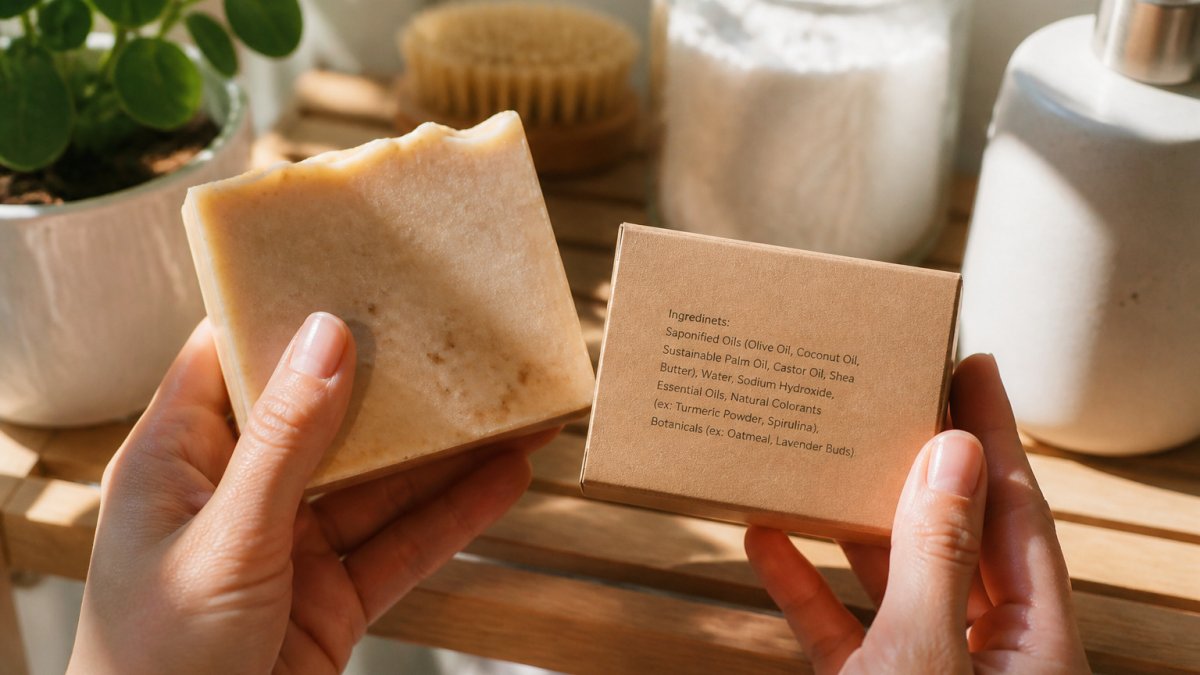
Labels use INCI names, which are standardized Latin-derived terms rather than marketing language. A few translations cover most bar soap and cleanser labels:
- Sodium olivate, soap made from olive oil
- Sodium cocoate, soap made from coconut oil
- Sodium palmate, soap made from palm oil
- Cocos nucifera (coconut) oil, the unreacted oil, often added as a superfatting agent
- Butyrospermum parkii, shea butter
- Glycerin, a humectant, sometimes retained from the soap-making process and sometimes added
- Kaolin, white clay used for slip and mild oil absorption
- Parfum or fragrance, an umbrella term that can cover essential oils, fragrance oils, or both
That last entry is the one to watch. A label that says "fragrance" or "parfum" does not tell you whether the scent came from plants or a lab, and it does not disclose the individual compounds inside the blend.
Marketing terms that are not regulated the same way
The FDA's cosmetics labeling guidance requires ingredient disclosure and prohibits false or misleading claims, but it does not define or certify terms like "natural," "clean," "pure," "green," or "chemical-free." Those words have no standardized legal meaning in the United States, so they function as marketing rather than as guarantees.
"Chemical-free" is the clearest red flag. Water is a chemical, and so is every oil, butter, and botanical extract. A brand using that phrase is signaling a marketing position, not a formulation fact.
The Alabaster | Unscented Plant-Based Artisan Soap →
Concentration and the finished formula
Two products can list identical ingredients and behave very differently because concentration, pH, and delivery matter. A 0.5% salicylic acid cleanser and a 2% salicylic acid leave-on treatment share an ingredient name but not an effect. Likewise, a soap's pH and its proportion of superfatting oils often influence how it feels on skin more than whether a given oil is natural or synthetic.
The table below sums up the label terms and ingredient names covered in this section, so you can scan them quickly.
| Label term or name | What it means | Note |
|---|---|---|
| Sodium olivate | Soap made from olive oil | Common in bar soap ingredient lists |
| Sodium cocoate | Soap made from coconut oil | Listed by its INCI name |
| Butyrospermum parkii | Shea butter | Latin-derived INCI term |
| Parfum or fragrance | Scent from essential oils, fragrance oils, or both | Does not disclose individual compounds |
| Natural, clean, pure | Marketing terms with no standardized legal meaning | Verify against the ingredient list |
| Organic | Agricultural ingredients must meet USDA rules | A cosmetic is not organic just because one ingredient is |
| Chemical-free | Marketing claim; water and oils are chemicals too | Treat as a red flag |
Common Soap Ingredients to Avoid, and Why
Not every ingredient belongs in every skin routine. Some common soap components can be harsh for people with dry, reactive, or eczema-prone skin. Synthetic detergents and high-foaming surfactants can strip natural oils, while heavy fragrance and certain essential oils are frequent triggers for irritation.
Be aware that avoiding an ingredient does not guarantee a gentle product. A soap can be free of all the usual irritants and still feel harsh if its pH is high or it is made with too little moisturizing fat. Look at the whole formula and how your skin feels after use.
Natural and Synthetic Preservatives in Skincare
Preservatives are the least glamorous ingredients in skincare. Their job is to keep water-containing products from becoming a growth medium for bacteria, yeast, and mold. That matters because contaminated creams and lotions can cause infections, especially on broken or eczema-prone skin, and because microbial growth is often invisible, a product can look and smell normal and still be contaminated.
Why water changes the safety equation
Microbes need water to multiply. A product with high water content, a lotion, cream, serum, or gel, is vulnerable, and that is why almost all water-based cosmetics rely on a preservative system. Anhydrous products (balms, oils, and bar soap) contain little or no free water, so they are far less hospitable to microbial growth. This is a formulation fact, not a natural-versus-synthetic one: a "natural" water-based cream without an effective preservative is riskier than a conventional cream with a well-tested preservative system.
Synthetic preservatives
Common synthetic preservatives include phenoxyethanol, the parabens, benzyl alcohol, and combinations such as phenoxyethanol with ethylhexylglycerin. These are widely used because they are effective at low concentrations, have been studied for safety, and remain stable across temperature and pH ranges that products encounter in real use. Parabens in particular have a long safety record at permitted use levels, though consumer preference has pushed many brands toward alternatives. The trade-off is that some preservatives are restricted or capped in concentration, and a few can irritate very reactive skin, so the specific preservative and its level matter more than the category label.
Natural and "preservative-free" claims
Natural preservative options exist, certain plant extracts, fermented ingredients, and essential-oil components have antimicrobial activity, but most offer a narrower spectrum of protection, are less predictable across formulations, and may fade over a product's shelf life. Some brands combine several natural antimicrobials to broaden coverage, which can work but requires more testing than a single proven system.
"Preservative-free" is the claim to treat most carefully. On an anhydrous bar or balm, it can be accurate and reasonable.
Stability and contamination testing
Reputable manufacturers run preservative efficacy tests (often called challenge tests), in which a product is deliberately inoculated with microbes to confirm the preservative system suppresses growth. They also run stability testing to check that the formula holds together over time and at temperature extremes. These tests are not visible on a label, but they are the practical difference between a product that stays safe through normal use and one that does not. For bar soap, the equivalent safeguards are careful formulation, low water content, and clean production.
Choosing a Soap for Your Skin: Next Steps
Start by identifying your skin's main needs. If you are reactive or prone to irritation, a fragrance-free formula gives you the most control. Our National Eczema Association's skin care recommendations offers useful background on choosing gentle cleansers.
For a gentle starting point, The Alabaster | Unscented Plant-Based Artisan Soap is a fragrance-free bar formulated with shea butter, olive oil and white kaolin clay. If you prefer a scent, The Dusk | Lavender Bergamot Essential Oil Soap is scented with orange, bergamot and lavender essential oils.


Whichever you choose, patch test a new bar on a small area for several days before using it everywhere. Read the ingredient list, weigh the concentration of any fragrance, and let your skin's response guide the final decision.
Frequently Asked Questions
What is the difference between natural and synthetic skincare ingredients?
Natural ingredients come from plants, minerals or animal sources and are typically extracted or minimally processed. Synthetic ingredients are made in a laboratory, sometimes to copy a natural molecule exactly, sometimes to create one that does not occur in nature. Neither category is automatically gentler or harsher. What matters is the specific ingredient, its concentration in the finished formula, and whether your skin has reacted to it before. Read the full ingredient list rather than relying on a 'natural' or 'synthetic' label.
Can natural skincare ingredients cause irritation or allergies?
Yes. Many natural ingredients, including essential oils such as lavender, tea tree and citrus oils, are common skin sensitizers. Plant extracts can also trigger contact dermatitis in people with sensitive skin. Because a natural product can still irritate, patch testing a new bar on a small area of skin for a few days is a practical first step before using it all over, especially if you react easily to fragrance.
How can you tell if a skincare ingredient is natural or synthetic?
The ingredient list usually gives clues. Botanical names such as Olea Europaea (olive) fruit oil or Butyrospermum Parkii (shea) butter point to plant sources, while names ending in words like polyquaternium or sodium laureth sulfate typically indicate synthetic or semi-synthetic compounds. Some ingredients are nature-identical, meaning they are made in a lab but match a natural molecule. The manufacturer's description will often state the source, and you can ask the company directly for sourcing information.
Are fragrance oils and essential oils the same in soap?
No. Essential oils are steam-distilled or cold-pressed from plant material and retain the plant's natural compounds, which can themselves be irritating. Fragrance oils are blended or synthesized to mimic a scent and may contain no natural plant material at all. Unscented or fragrance-free soaps still contain some natural aroma from butters and oils, so a 'fragrance-free' bar is not the same as one with no scent at all.
